Open to everyone, including your first-ever class
We don’t run a separate beginners mat stream, and it isn’t an oversight.
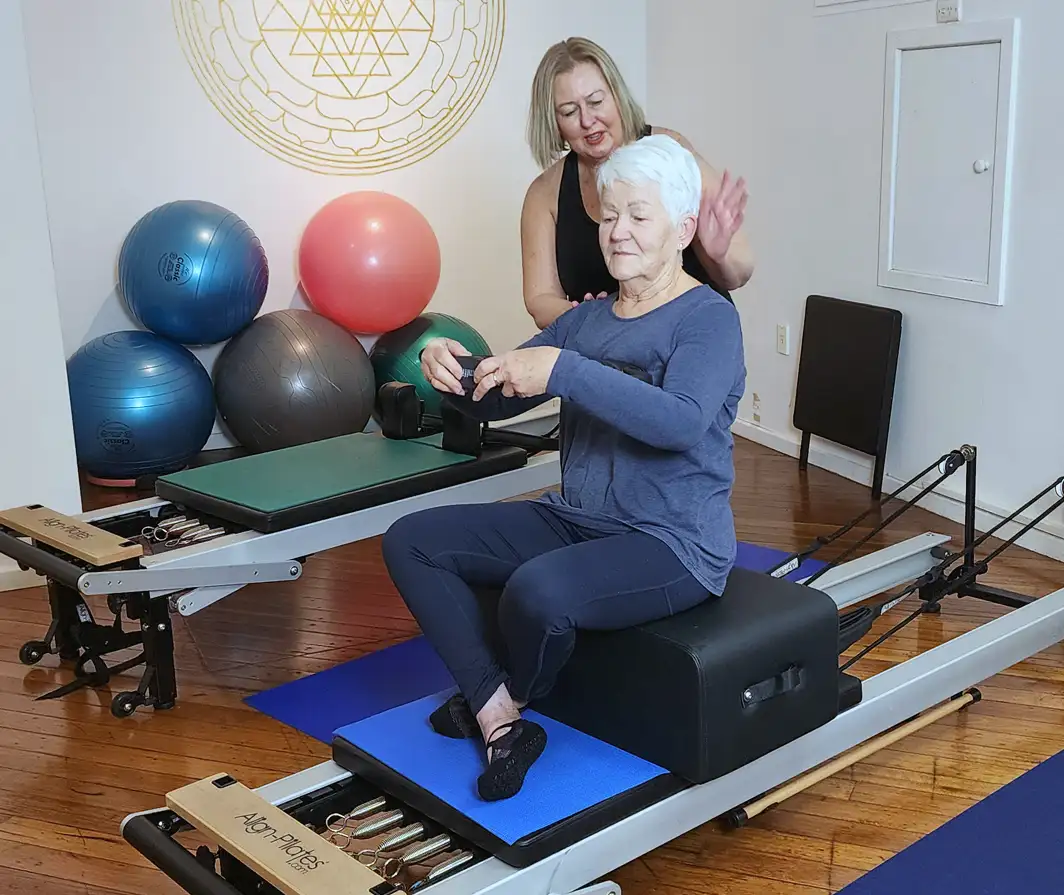
On the reformer, you have to learn a machine before you can learn the movement — which is why the reformer has its own beginners pathway. On the mat there’s nothing between you and the exercise. So the class is open, and every movement is taught with a version that suits the body doing it.
In practice that means: book any mat class on the timetable, whatever your experience. Tell your teacher when you arrive that it’s your first one. You’ll be given a version of each exercise you can do today, and a harder one when you want it. Nobody announces who’s doing which — modifying is what everyone in the room does, at every level.
If something’s going on — a sore back, a recent surgery, a knee that objects to kneeling — mention it before class and the work gets adjusted around it quietly.
→ Nervous about starting at all? Beginners Pilates in Wollongong covers what the first class is actually like.
What a mat class is like
Sixty minutes, mats down, small group.
You’ll start with a warm-up that wakes up the parts of you that have been sitting still, then move into the work itself — deep core, pelvic floor, spine, hips, shoulders. Breath is taught out loud rather than assumed, because it’s what makes the rest of it work.
Small equipment comes out when it’s useful: resistance bands, soft balls, light hand weights, the barre. None of it is required and none of it is a test — it’s there to make an exercise more accessible or more demanding, depending on which you need.
The class finishes with stretching, and you leave looser than you arrived.
What runs through all of it is pace. Nothing is done fast to make it feel harder. Exercises are done well, then done again slightly better. That’s the whole method.
This is not gym-style Pilates. No cardio intervals, no timed rounds, no counting reps at volume, no music you have to shout over.
What to Expect in Class
Bodyweight work on the mat gives you nothing to borrow from — no springs, no momentum — so what you build is genuinely yours.
- Deep core and pelvic floor strength — the muscles that hold you up rather than the ones that show. Useful for back comfort, continence and everything you lift or carry.
- Posture that survives a workday — ribs stacked over hips, shoulders where they belong, without having to think about it by week six.
- Mobility through stiff joints — hips, spine, shoulders. Length built alongside strength rather than instead of it.
- Balance and coordination — which is what actually protects you from a fall in your seventies, and is trained far earlier than most people think.
- A quieter head — an hour of paying attention to one thing does something that isn’t strictly physical, and most members mention it before they mention their abs.
You can also do it at home. Nothing you learn on the mat needs equipment, which makes it the version of Pilates that keeps going when you’re travelling or the week falls apart.
Pilates Mat classes are currently held Tuesdays and Thursdays at 9.00 am, Sundays 10.00 am
Who’s in the room
Mostly women between their forties and their seventies, though not exclusively — and in any given class you’ll find someone in their first week working next to someone in their eighth year, both at the edge of what they can currently do.
That mix isn’t us making do with one class. Mixed-level mat teaching is how Pilates has been taught since Joseph Pilates taught it, and it’s the reason the mat repertoire contains so many variations of the same exercise in the first place.
Our teachers are experienced with mature bodies, with old injuries, and with people who haven’t exercised in a long time. They’ll watch how you move rather than how hard you’re working — which is the part no machine and no app can do for you.
Mat or reformer?
Short version: mat is you and gravity, reformer is you plus springs. Mat has nothing to learn before you start and travels with you. Reformer gives you load and support the mat can’t. Most people end up doing both, and if you only want one to begin with, start with whichever you can get to regularly — consistency beats the choice.
→ The longer answer: Should you start on the mat or the reformer? → About Reformer Pilates · All our Pilates classes
Your first mat class
Arrive ten minutes early and tell reception it’s your first class. We’ll show you where to put your things and introduce you to your teacher before it starts.
Mats and all small equipment are provided. Bring water. That’s it.
Wear something you can move in — leggings or shorts and a fitted top are ideal, so your teacher can actually see how you’re moving.
Grip socks aren’t required for mat classes. They’re required on the reformer, so if you’ve read that elsewhere on our site, it doesn’t apply here. Bare feet or socks, whichever you prefer.
Parking — street parking on Keira Street, and the Wollongong Central car park is a short walk.
If you’re not sure a mat class is the right first one, call 02 4226 3777. Two or three questions and we’ll tell you.
Timetable and passes
Mat classes run several mornings a week — check the live timetable for current days and times.
New to the Wellness Centre? Our introductory pass is the cheapest way to try a few classes before committing to anything.
New to the Wellness Centre and live in the Illawarra?
Grab a 3 Class Into Pass for only $30
Common questions
Do I need to do a beginners course before joining a mat class?
No. Mat classes are open to everyone and every exercise is taught with a version you can do. Book straight in and tell your teacher it’s your first class.
I'm not fit or flexible. Is that a problem?
No — that’s what the classes are for. Flexibility is an outcome of Pilates, not a requirement for it.
Will I hold the class up?
No. Teachers offer options as part of teaching the exercise, not as an interruption for one person. You won’t be singled out and the class won’t stop.
How many people are in a mat class?
Small enough that corrections stay individual. The beautiful, spacious Studio 1 has plenty of room with classes currently capped at 12. Mats and small equipment are supplied: balls, magic circles, bands and light weights.
I've got a back that flares up. Can I still come?
Usually yes, and it’s why a lot of people start on the mat rather than the reformer. Tell your teacher before class. If something needs assessing rather than adjusting, we’ll say so and suggest you see a practitioner first.
Can I use a mat class pass for other classes?
After your Intro pass, Mat classes are covered by the Studio1 passes & memberships They also include Hatha, Vinyasa, Yin & Restorative Yoga and iRest Yoga Nidra Meditation.
Is mat Pilates enough on its own, or do I need the reformer too?
It’s enough on its own. Plenty of members have done nothing but mat for years. The reformer adds load and variety when you want them, not because the mat is incomplete.
Start on the mat
Book a class, or call and we’ll help you pick one.