Seven reformers
Beginners welcome
Technique before tempo
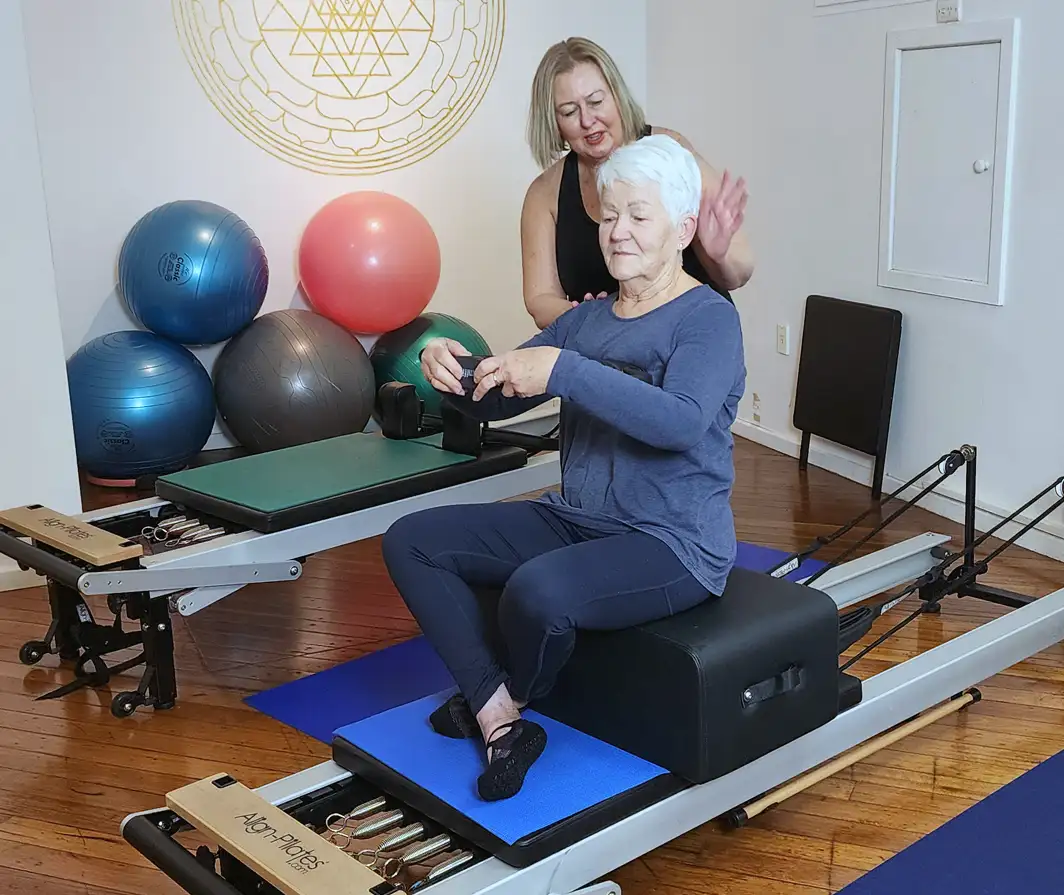
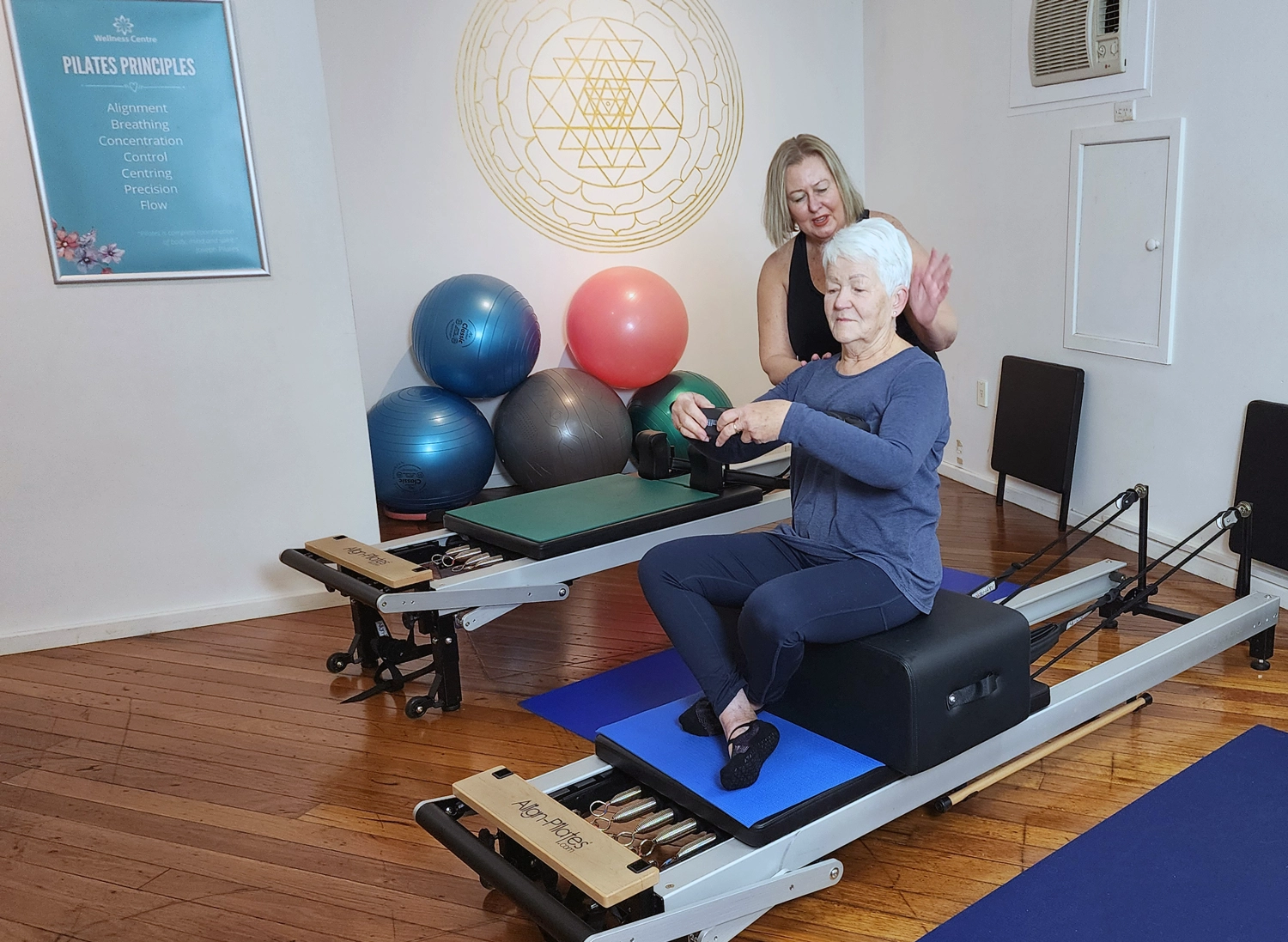
Individual corrections
Calm studio
Where to start
Four ways in, depending on where you’re up to. If you’ve never been on a reformer, begin with an Orientation … it takes thirty minutes and it’s the easiest first step there is.
Reformer Orientation
30 minutes
New to the reformer? Start here.
A calm thirty minutes with a teacher and a machine. You’ll learn what the springs, straps, footbar and carriage do, move through a few foundation exercises, and cover how a class runs — including the small practical things nobody tells you.
Not a workout. Just a comfortable place to begin.
Reformer Foundations
The method, taught from the ground up.
Foundation exercises at an unhurried pace, with breath and alignment taught rather than assumed. Nothing is expected of you in advance — and plenty of our long-standing members still come back to Foundations regularly to sharpen their technique.
No experience needed · Max 7
Reformer Pilates
Our everyday class.
A full-body sequence — footwork, legs, arms, spine and centre — with the springs supporting some movements and loading others. Considered in pace, varied week to week, and adjusted to you as you go.
Some reformer experience · Max 7
Reformer Strength & Mobility
Heavier springs. Slower tempo.
Resistance work through the legs, back and arms — genuinely weight-bearing — paired with mobility work for the hips, spine and shoulders. Fewer repetitions, more attention to each one. A substantial class that never chases you.
Foundations or equivalent · Max 7
Not sure which suits you? Call us or send an enquiry … we’ll ask two or three questions and point you to the right one.
What a class is actually like
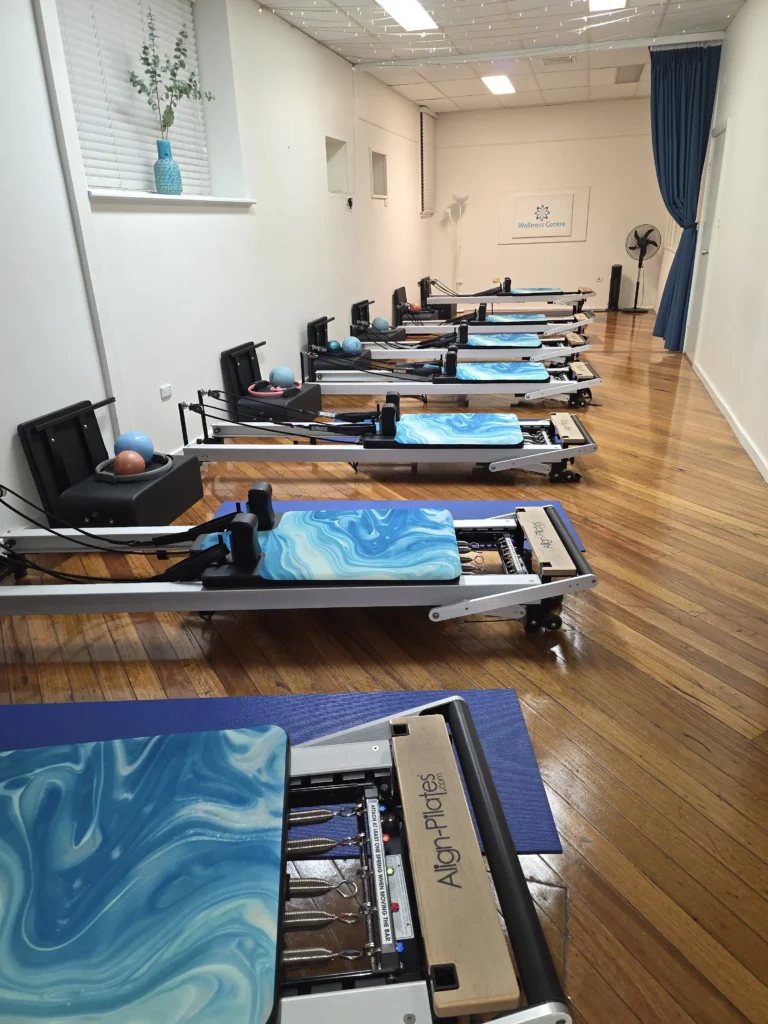
Seven reformers, one teacher, and enough space that nobody is working in anybody’s way.
You’ll be shown your spring setting for each exercise rather than left to guess it, and there’s time to change it without hurrying. Your teacher will move around the room throughout — adjusting a foot position here, a rib placement there — so corrections happen quietly and individually rather than being called across the studio.
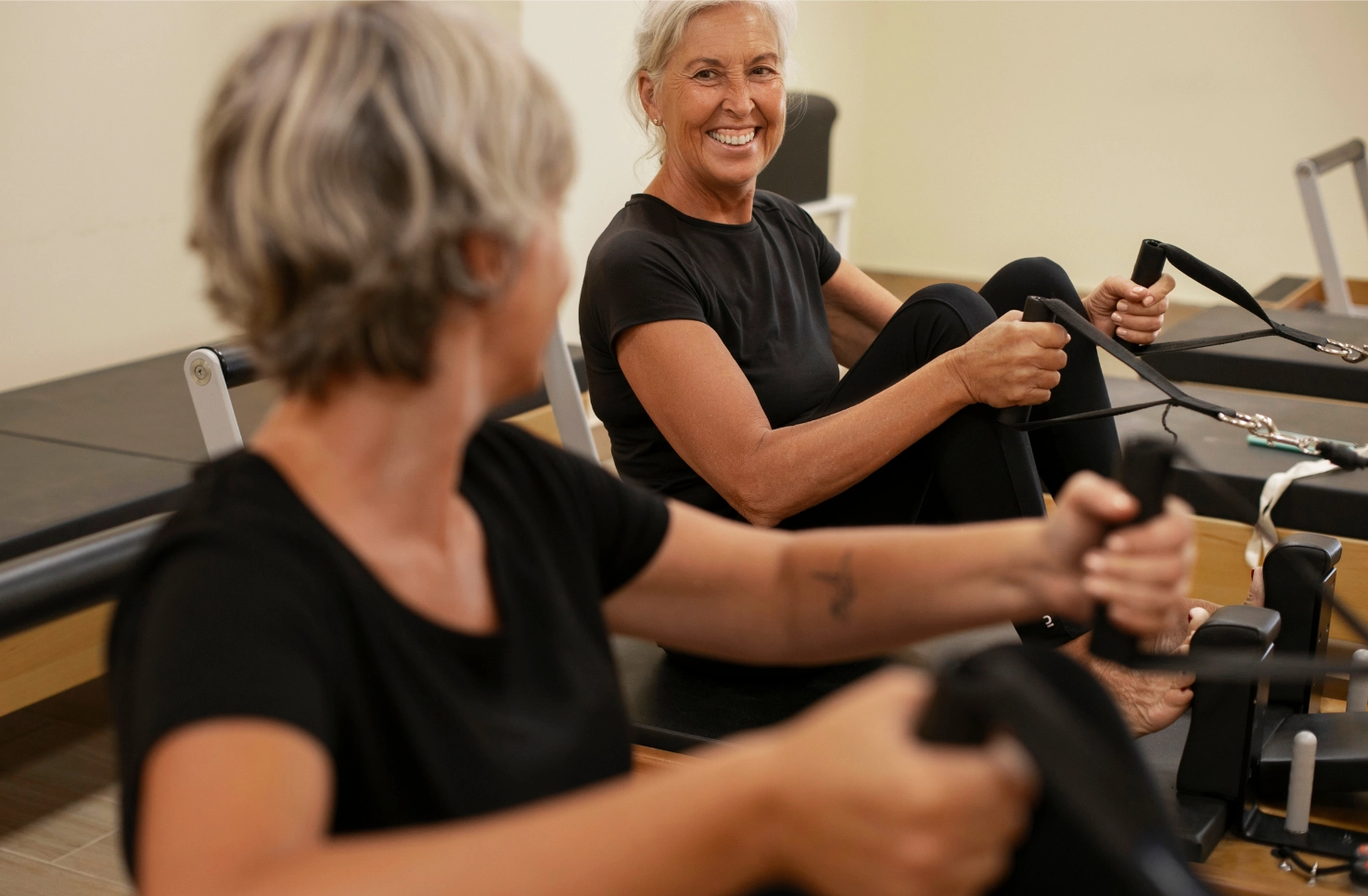
The room is mixed. Most of our members are women somewhere between their forties and their seventies, and in any given class you’ll find people in their first month working alongside people in their eighth year. Nobody is watching anybody else.
The music is on, and it’s quiet enough to hear what your teacher is saying. Lights are up. Nothing is heated.
You’ll work. You just won’t be rushed while you do it.
Is this you?
Most people who book their first class here recognise at least one of these.
- You've never used a reformer and the machine looks more complicated than it is
- You've tried a fast-paced reformer class and spent most of it a beat behind
- You're returning to exercise after illness, injury, surgery or a long stretch away
- There's something in your body — a knee, a shoulder, a back, a hip — that needs working around
- You want to get genuinely stronger, without a class that outruns you
- You'd rather be in a room of seven than a room of twenty-four
- You’re somewhere past 45 and you’ve noticed strength, balance or bone health moving up your list of reasons to exercise
- You’ve been told to do weight-bearing exercise and you’re not sure what that means in practice, or where to do it
You don’t need to be fit, flexible or experienced. You need to start, and we’ll do the rest.
How we teach
Our classes are built on the principles Joseph Pilates set out — concentration, control, centring, flow, precision and breathing. In practice that means we teach breath explicitly rather than mentioning it, and we care more about how an exercise is done than how many times it’s repeated.
This is not gym-style Reformer Pilates. There are no cardio intervals, no timed rounds and no pushing through. What there is instead is load, applied deliberately, with your teacher watching how your body is managing it.
Our teachers are experienced with mature bodies, with injuries and with people who haven’t exercised in a while. Tell them what’s going on before class and the work will be adjusted — quietly, without any fuss, and without you being singled out.

What Reformer Pilates does for your body
The reformer’s springs do two useful things at once: they assist movements your body isn’t ready to do unsupported, and they load movements it is. That combination is why the same class works for someone rebuilding after surgery and someone chasing real strength.
Over a regular practice, most members notice:
- Strength through the legs, hips, back and shoulders — and weight-bearing load through the spine and lower limbs
- Mobility in the hips, thoracic spine and shoulders, which is usually where stiffness shows up first
- Balance and stability, trained deliberately rather than incidentally
- Posture and spinal support, from strengthening what holds you upright
- Confidence in movement — the practical kind, getting off the floor or out of a low chair
- A quieter head, which most people mention within a few weeks

AFTER 45
Starting, or starting again, in your forties, fifties and sixties
Most of the people in our reformer room are between their forties and their seventies. Not because we run a separate class for them — because that is who books.
If you are reading this somewhere past 45, you have probably arrived for one of three reasons. Something has changed and you have noticed it: stairs, a jar lid, getting up off the floor with a grandchild. Someone has told you to start strength or weight-bearing work — a GP, a physiotherapist, a scan result. Or you used to be active, life took fifteen years, and the gym now looks like somewhere designed for other people.
All three end up in the same place, and it is a reformer in a room of seven.
The reason the machine suits this decade particularly well is the springs. They assist a movement your body is not ready to do unsupported, and they load one it is — often within the same exercise. That means you can work genuinely hard through a joint that would not tolerate the same load standing up, and you can be given more as you get stronger without ever needing to be brave about it.
What the work is actually for
Muscle you would otherwise lose
Muscle mass declines steadily from around the fourth decade unless something asks it not to. Resistance work is the thing that asks. This is the single strongest argument for starting now rather than at 60.
Weight-bearing load through the spine and legs
Bone responds to being loaded. Reformer Strength & Mobility is our most weight-bearing class — heavier springs, slower tempo, real resistance through the legs, back and arms.
Balance, trained on purpose
Balance is a skill, not a fixed quantity, and it responds to being practised. We train it deliberately rather than hoping it turns up as a side effect.
Hips, mid-back and shoulders
Stiffness shows up in those three first, and it is what makes reaching, turning and looking over your shoulder in the car feel harder than it did.
If bone density is your reason for being here — a recent scan, a family history, or your doctor raising it around menopause — say so when you book. It changes which class we point you at and which exercises your teacher chooses. Loaded, controlled, weight-bearing work is what you are after, and there are a handful of movements we would leave out. Your teacher will know which ones.
The menopause years
A good number of women arrive here somewhere in the perimenopause or just after, usually because sleep, joints, body composition or all three have shifted at once and the exercise that used to work has stopped feeling like it does. This is not a menopause class and we are not going to pretend otherwise. It is a strength and mobility practice in a small, unhurried room, taught by people who have seen a great many women through exactly this stretch — which, for most of them, turns out to be the useful thing.
Working around things
The bodies we see most often
Almost nobody arrives in this decade with nothing to work around. Here is where the common ones sit — a guide, not a ruling, and the conversation still happens before your first class.
| What’s going on | Where you’d start |
|---|---|
| Nothing in particular — just out of practice | Orientation, then Foundations. The most common starting point on this page, and the least dramatic. |
| A knee or hip replacement, fully healed and cleared | Usually yes. The reformer is well suited to it — supported, controlled, no impact. Bring whatever range-of-movement limits your surgeon or physio gave you. |
| Osteopenia or osteoporosis on a scan | Yes, with specific exercises left out. Loaded weight-bearing work is the point; deep forward flexion and hard spinal twisting are the usual omissions. Tell us before you book so you start in the right class. |
| Osteoarthritis, stiff or sore joints | Usually yes, and often better than floor work — the carriage takes the weight while the joint still moves. Spring load gets adjusted rather than the exercise being skipped. |
| A long-standing back | Yes — it’s one of the commonest reasons people start here. Tell your teacher which movements provoke it, not just that it hurts. |
| Pelvic floor symptoms, leaking, heaviness | Yes, with the load managed. Very common after 45 and rarely mentioned. It changes which abdominal work we choose. If it is happening regularly we will suggest a women’s health physiotherapist alongside, not instead. |
| Heart condition, recent surgery, uncontrolled blood pressure | Talk to your doctor first, and bring us what they say. We would rather tell you that than take the booking. |
| Something that flares unpredictably | Yes — and this is what a room of seven is for. Your teacher can see you and change what you are doing on the day. |
A gentle note
Our classes are movement and wellbeing practice. They are not medical care or physiotherapy, and nothing here is a diagnosis or a treatment plan. If you have been given specific advice about bone density, joints, your heart or your pelvic floor, that advice comes first — bring it to us and we will shape the work around it.
If you are not sure whether exercise is right for you at the moment, please talk to your GP before you book. And tell your teacher if anything changes.
Your first visit
Arrive ten minutes early. There’s metered street parking on Keira Street and the Wollongong Central car park is a short walk.
Wear something comfortable you can move in — leggings or shorts and a fitted top are ideal, so your teacher can see how you’re moving. Grip socks are required for safety and hygiene; if you don’t have a pair, we sell them at reception.
Bring water. Everything else is here.
When you arrive we’ll show you where to put your things, introduce you to your teacher and get you set up on a reformer before class starts. If it’s your first class, tell us … we’ll make sure you’re looked after.
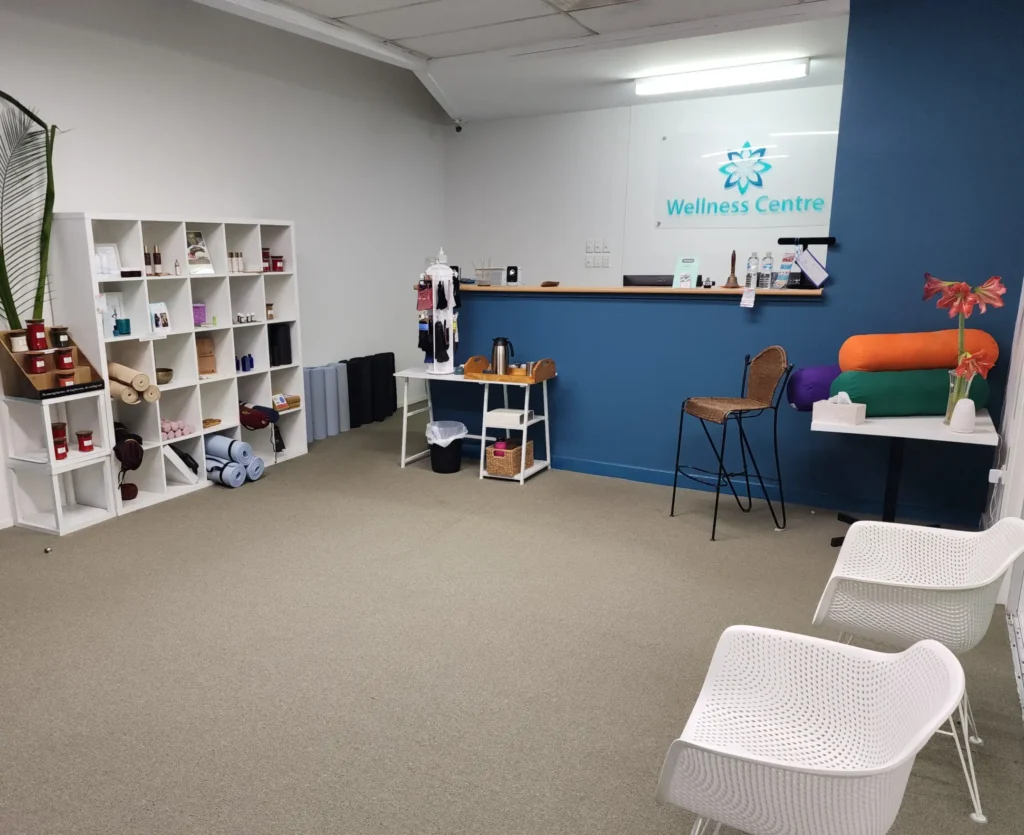
Intro offers
Our introductory passes are the easiest way to start, and they work across Reformer, Matwork, Yoga and iRest Yoga Nidra Meditation … so you can find what suits you rather than committing to one thing.
Common Questions
I've never done Pilates before. Where do I start?
With a Reformer Orientation, then Reformer Foundations. The Orientation takes thirty minutes and covers the equipment; Foundations teaches the movement itself. Most people spend six to ten Foundations classes before moving into our general Reformer Pilates class … though there’s no test and no hurry.
I'm in my sixties. Will I be the oldest person there?
Almost certainly not. Most of our members are women between their forties and seventies, and our teachers are experienced with mature bodies. Age isn’t what determines which class suits you … experience and what your body is currently managing are.
: I have an injury, or something that flares up. Can I still come?
In most cases yes, and it’s the reason many people start here. Tell your teacher before class and the work will be adjusted. If something needs assessing rather than adjusting, we’ll say so and suggest you see a practitioner first — we’d rather tell you that than take the booking.
Is this the same as gym-style Reformer Pilates?
No. The pace is slower, the classes are capped at seven, and corrections are given individually. You’ll work … but you won’t be hurried through it.
How many people are in a class?
Seven at most. We have seven reformers and we don’t overbook.
Do I need grip socks?
Yes, for every Reformer class. Available at reception if you need a pair.
Is Reformer Pilates good for bone density?
Bone responds to being loaded, and loaded resistance work is what Reformer Strength & Mobility is built around — heavier springs, real weight-bearing work through the legs, spine and arms, done slowly enough to be done properly.
What we will not tell you is what it will do to your numbers. That is between you, your doctor and your next scan. What we will do is make sure the class you are in is the loaded one rather than the gentle one, and that the handful of movements usually left out for low bone density are left out. Tell us at reception and it is handled from your first class.
I’m 58 and I haven’t exercised in fifteen years. Is this too advanced?
No, and it is close to the most common way people arrive here. Start with a Reformer Orientation — thirty minutes, one teacher, one machine, no class watching. Then Foundations, where nothing is assumed and the pace is set by teaching rather than by the clock.
Most people spend six to ten Foundations classes before moving on, and some stay longer because they like it. There is no test and nobody is counting.
I’m going through menopause and everything feels harder. Will this help?
A lot of women in exactly that position train here, and what they tend to say is that strength work is the thing that made the difference — not because it fixed anything, but because being stronger made the rest more manageable.
We are not going to promise you anything about symptoms. What we can promise is a small room, a teacher who knows what this stage does to sleep, joints and energy, and a class that will not humiliate you on a bad week.
I’ve had a knee (or hip) replacement. Can I do reformer?
Usually yes, once you are fully healed and your surgeon or physiotherapist has cleared you for exercise. The reformer is well suited to it: the carriage supports your weight, there is no impact, and the load is adjustable in small increments.
Bring us any range-of-movement limits you have been given — particularly anything about deep flexion or crossing the midline — and your teacher will work inside them.
Is this better than going to the gym at my age?
Different, rather than better. A gym will give you heavier absolute load and more equipment. What it will not give you is somebody watching how you are managing that load, in a room of seven, who will change it before something hurts.
Plenty of our members do both. If you are going to do one, and you have not lifted anything in a decade, this is the easier place to start and the harder place to hurt yourself.
Not sure where you’d fit
Start with thirty minutes and a machine
A Reformer Orientation is one teacher, one reformer and no class watching. Tell us what’s going on with your body and we’ll point you at the right class from there.
or Call 02 42263777 – Text 0483941487
Client Testimonials
Cheryl (60 years)

“The Wellness Centre is simply a godsend. The instructors are vastly experienced and extremely knowledgeable. Best investment in my fitness and wellness I’ve ever made.“
Sofia